







Why a modular sewage treatment plant loses nitrification in winter
Why a modular sewage treatment plant loses nitrification in winter
When ammonia levels rise as temperatures fall, operators need to know whether cold weather alone is responsible—or whether operating conditions are making the problem worse. A modular sewage treatment plant can lose nitrification in winter because slower-growing nitrifying bacteria need more time and adequate biomass retention to maintain treatment performance. Low dissolved oxygen, insufficient alkalinity, and sudden load changes can compound the decline.
The practical question is not simply how to warm the tank. It is which constraint is preventing ammonia conversion, and what can be corrected before chemical consumption or equipment costs increase.
Cold weather exposes a process with little operating margin
Nitrifying microorganisms convert ammonia to nitrite and then nitrate. Their growth and activity slow as wastewater cools. Organic matter removal may remain acceptable while ammonia breaks through, so clear effluent and satisfactory carbon removal do not prove that nitrification is healthy.
Compact treatment systems can be particularly sensitive when their summer performance depends on limited biological volume, short aeration periods, or a small nitrifier population. Above-ground tanks and exposed pipework may also lose heat, although the significance depends on insulation, incoming wastewater temperature, flow, and site conditions.
Distinguish hydraulic retention time from solids retention time. Water may remain in a tank long enough for treatment under warm conditions, while nitrifiers are removed faster than they can reproduce in winter. In suspended-growth systems, sludge wasting and solids losses control this risk. In attached-growth systems, carrier retention, active biofilm, mixing, and oxygen delivery become central.
Read the pattern before changing the process
Start by confirming the ammonia result. Check sampling location, test procedure, instrument condition, and reporting units. Then compare results with actual biological-tank temperature—not outdoor air temperature—and review flow and ammonia load over the same period.
- A gradual decline alongside cooling: investigate whether winter biomass inventory and aerated treatment time are sufficient.
- A sudden ammonia increase: check blower operation, power interruptions, industrial discharges, cleaning chemicals, and unusual inflow before blaming temperature.
- Ammonia breakthrough during peak flow: examine hydraulic loading, equalization, short-circuiting, and solids carryover.
- Increasing nitrite: this indicates incomplete nitrification, but does not identify a single cause. Review oxygen, pH, temperature, and possible inhibition together.
Measure influent and effluent ammonia alongside nitrite and nitrate where practical. Interpret nitrate carefully: an anoxic stage may remove it, so low final nitrate does not necessarily mean ammonia oxidation has stopped.
Check oxygen where the biomass actually needs it
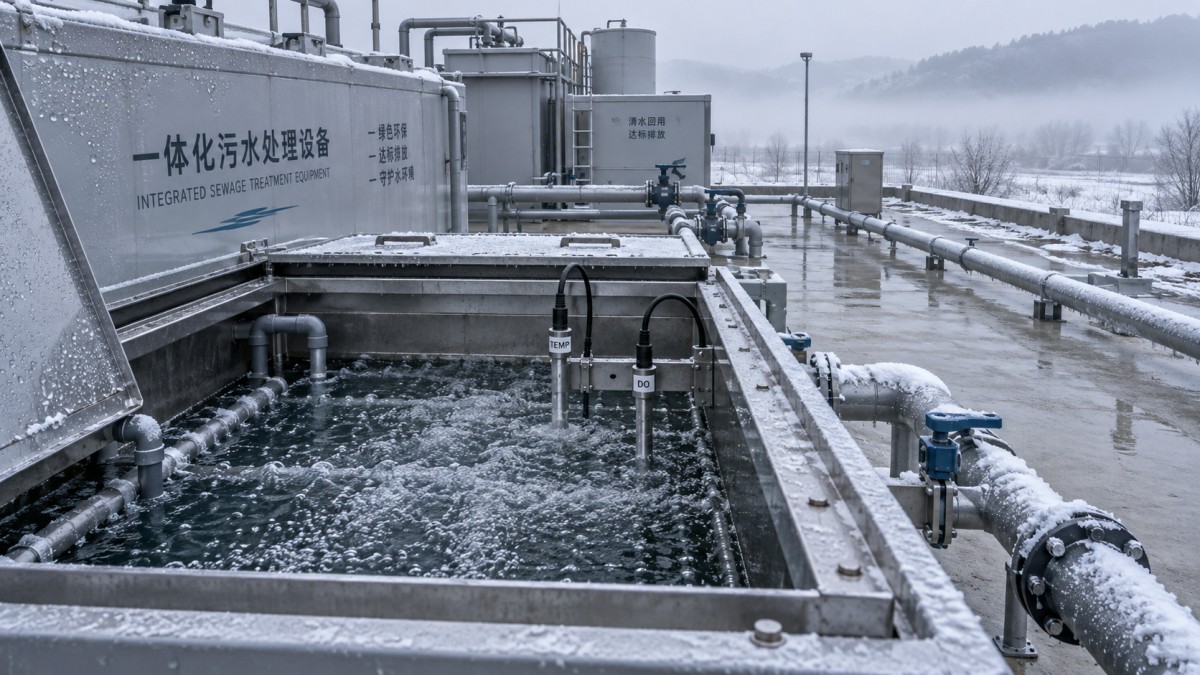
A normal dissolved oxygen reading near one diffuser does not establish adequate oxygen throughout the reactor. Check several locations and depths, especially during peak loading and near the end of an aerated cycle. Verify probe calibration and inspect diffusers, air distribution, valves, and blower delivery.
Cold water can hold more dissolved oxygen, but that does not guarantee oxygen reaches flocs or penetrates biofilm. Poor mixing, uneven aeration, or excessive biofilm thickness can leave active organisms oxygen-limited even when a bulk-water reading appears reassuring.
For intermittently aerated plants, review actual aerobic time as well as the oxygen setpoint. Extending aeration may help ammonia removal, but it can reduce anoxic time and affect total nitrogen removal. Avoid simply maximizing blower output: correct distribution problems and verify the biological response before accepting higher energy use.
Protect biomass without overloading solids separation
In activated-sludge modules, calculate actual solids retention time using the system solids inventory and solids leaving through both wasting and effluent. Continuing a summer wasting schedule into colder operation can gradually remove the nitrifier population needed for winter treatment.
Reducing wasting may be appropriate, but stopping it indefinitely is not a reliable recovery strategy. Excess solids can impair mixing, increase oxygen demand, and overload the clarifier. Track sludge settling, blanket depth, return-sludge performance, and effluent suspended solids while adjusting biomass inventory.
For moving-bed or other attached-growth modules, confirm that carriers remain in the reactor and move as intended. Inspect retention screens and look for stagnant zones. Adding media without checking mixing capacity, oxygen delivery, and the original design can create a different limitation rather than solve the existing one.
Separate alkalinity deficiency from a dosing assumption
Nitrification consumes alkalinity. If buffering becomes insufficient, pH can fall and further suppress biological activity. A single acceptable influent pH reading is not enough: assess residual alkalinity and pH through the biological process, including periods of high ammonia loading.
When testing confirms a shortfall, controlled alkalinity addition may be justified. A Dosing Unit (Sewage Treatment / Waterworks / Water Supply System) can support that correction when configured for the selected chemical, required feed range, and control method. Chemical compatibility, calibration, containment, and safeguards against overdosing still require project-specific review.
Do not treat dosing as a substitute for biomass retention or oxygen supply. Likewise, disinfectants are not nitrification aids. Investigate unintended oxidant entry or chemical cleaning residues if biological performance drops abruptly.
Recover methodically, then prepare for the next cold period
Correct equipment failures and harmful influent changes promptly. Where equalization is available, use it to moderate loading peaks within its operating capacity. Then adjust wasting, aeration, or alkalinity according to the measurements. Record each change so that an improvement—or deterioration—can be traced to a plausible cause.
Biomass recovery is not immediate, particularly in cold water. Follow ammonia load removed as well as effluent concentration; dilution alone can make the outlet result look better. If compliance is threatened, use the site’s approved contingency arrangements rather than waiting for biological recovery without a plan.
Shandong Wit Environmental Protection Technology Co.Ltd’s wastewater work spans municipal, industrial, and aquaculture applications. That breadth is relevant to diagnosis because similar ammonia symptoms can originate from different influent conditions. A useful engineering review should connect wastewater characteristics with biological capacity, controls, and solids handling—not begin with a predetermined equipment upgrade.
Before the next winter, compare the modular sewage treatment plant’s design basis with measured minimum wastewater temperature, peak ammonia loading, and achievable biomass retention. If a verified capacity gap remains after operational faults are corrected, evaluate insulation, additional biological capacity, or process modifications against that specific gap.



 Why a modular sewage treatment plant loses nitrification in winter
 When does a modular sewage treatment plant cost less than civil works?
 What pretreatment requirements must be met before feeding raw water to Large-Scale Integrated Skid-Mounted Water Purification Treatment Equipment?
 What scalability limitations exist for Large-Scale Integrated Skid-Mounted Water Purification Treatment Equipment in phased expansion projects?
 What footprint reduction does Large-Scale Integrated Skid-Mounted Water Purification Treatment Equipment deliver versus conventional concrete plants?
 How ConstantPressure Water Supply Skid-Mounted Equipment avoids water hammer during pump start-up in district heating networks
GET A FREE QUOTE
Service Commitment: Upon receipt of your message, a dedicated representative will contact you as soon as possible to provide efficient and professional service support.
