







Which Discharge Standards Should Integrated Domestic Sewage Treatment Equipment Meet?
Which Discharge Standards Should Integrated Domestic Sewage Treatment Equipment Meet?
The most common mistake in buying Integrated Skid-Mounted Domestic Sewage Treatment Equipment is to ask for a treatment process before confirming the discharge target. In practice, the discharge standard determines almost everything that follows: process route, footprint, power consumption, sludge management, automation level, and whether the system can stay compliant after seasonal flow changes. If the effluent target is vague, even a well-built package unit can become a poor procurement decision.
For domestic sewage projects in China, discharge compliance is usually judged against national or local wastewater standards, not against a generic promise such as “meeting environmental requirements.” The actual benchmark depends on where the treated water goes. Discharging into a municipal sewer, discharging into surface water, reusing water on site, and sending flow to a polishing wetland are different regulatory situations. A compact skid-mounted unit may be suitable for all of them, but not with the same process configuration or the same guaranteed effluent indicators.
What procurement teams should confirm before comparing equipment
There is no single discharge standard that applies to every integrated domestic sewage treatment project. The key questions are more specific:
- Is the effluent discharged directly to a river, lake, or other surface water body?
- Is it discharged into an urban drainage network and then sent to a municipal wastewater plant?
- Is the treated water intended for non-potable reuse such as greening, road washing, or landscape replenishment?
- Does the project sit in a sensitive watershed, rural settlement, scenic area, school, hospital, or decentralized community with local environmental controls?
Those questions matter because the standard is not selected by equipment type. It is selected by receiving environment, project approval requirements, and local supervision practice. Integrated equipment is only the carrier. Compliance lives in the effluent data.
For many direct-discharge domestic sewage projects, buyers in China will encounter the framework of GB 18918-2002, the Discharge Standard of Pollutants for Municipal Wastewater Treatment Plant. In actual projects, the discussion often centers on whether the unit must meet Class 1A, Class 1B, or another locally required control level. Class 1A is frequently referenced because it sets relatively strict limits on major pollutants such as COD, BOD5, suspended solids, ammonia nitrogen, total nitrogen, and total phosphorus. But that does not mean every decentralized skid-mounted unit must always be procured to Class 1A. In some cases, local rules, receiving water function, or the downstream treatment arrangement may lead to a different requirement.
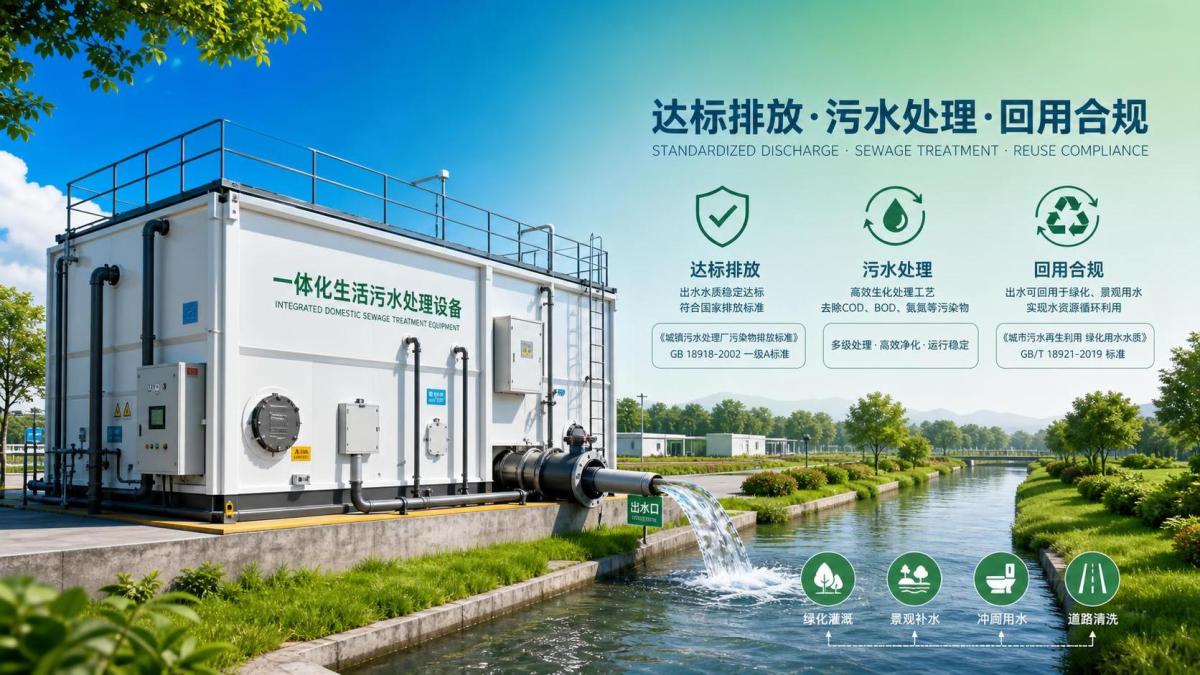
This is where experienced suppliers matter. Shandong Wit Environmental Protection Technology Co.Ltd has worked across municipal wastewater, industrial wastewater, aquaculture wastewater, ecological restoration, and constructed wetlands, which is relevant because integrated domestic sewage projects rarely operate in isolation. A packaged unit may need to connect with a drainage network, a reuse system, a disinfection stage, or an ecological polishing section. From a procurement perspective, the standard should be judged together with the whole treatment path, not only the equipment nameplate.
The standards that usually come up
In domestic sewage treatment procurement, these are the standards and control paths most often discussed:
That table is intentionally practical. Procurement failure usually happens in the gap between “the unit can treat sewage” and “the unit can meet this exact discharge path under this exact operating condition.”
A standard is not just a list of pollutant numbers
When people talk about discharge standards, they often focus only on COD and ammonia nitrogen. That is too narrow. For integrated domestic sewage systems, compliance also depends on how the equipment handles hydraulic fluctuation, low winter temperatures, sludge accumulation, influent oil and grease, intermittent occupancy, and disinfection control. Hotels, schools, rural settlements, service areas, construction camps, and scenic sites produce very different flow patterns even if all are labeled “domestic sewage.”
This is one reason skid-mounted integrated systems are popular: they shorten installation time and standardize delivery. But standardization should not be confused with universal suitability. A unit designed around stable residential sewage may struggle in a site with long no-flow periods followed by peak surges. In those cases, asking whether the equipment “meets the standard” is incomplete; the better question is whether it can still meet the standard under the project’s real influent pattern.
Some buyers also assume that if a supplier offers an integrated water treatment product, it can be freely substituted across sewage and water purification duties. That is rarely a safe assumption. For example, Small-Sized Integrated Skid-Mounted Water Purification Treatment Equipment serves a different treatment objective from domestic sewage discharge control, even though both may use compact modular design. Procurement documents should distinguish clearly between water purification, wastewater treatment, and reuse polishing functions.
What to ask suppliers before making a decision
A competent supplier should be able to answer a short but demanding set of questions:
- Which exact discharge or reuse standard is the design based on?
- What influent assumptions were used for COD, BOD5, SS, NH3-N, TN, TP, and peak flow?
- Is the guarantee based on average conditions or peak seasonal conditions?
- What pretreatment, sludge handling, and disinfection steps are included in the skid?
- How is operation affected by temperature, intermittent inflow, and maintenance frequency?
- What local project references or operating experience support the selected process route?
These questions are more useful than broad claims about “advanced technology.” Companies with a real engineering base, especially those involved in whole-process consulting and public-sector environmental projects, are usually better positioned to align discharge compliance with site conditions. That alignment is often more valuable than chasing the lowest bid.
In practical terms, Integrated Skid-Mounted Domestic Sewage Treatment Equipment should meet the discharge standard required by the project approval and receiving environment, often with reference to national standards such as GB 18918-2002 and, where applicable, stricter local requirements or reuse criteria. The procurement task is to verify that the promised compliance matches the actual discharge route, influent variability, and operating boundary. If that part is done well, equipment comparison becomes rational. If it is skipped, technical risk is simply postponed until commissioning.


 When Does a Small Water Purification System Outperform Centralized Treatment? Use Cases in Disaster Response and Mining Camps
 Small Water Purification System for Remote Clinics: Power-Independent Options and WHO Drinking Water Guidelines Compliance
 Ultrapure Water Equipment ROI Calculator: Estimating Payback Period Based on Yield Improvement and Defect Reduction
 How Ultrapure Water Equipment Validates Compliance with SEMI F63-1118 for 28nm+ Wafer Fabrication
") Ultrapure Water Equipment for Semiconductor Manufacturing: Key Specifications Beyond Resistivity (TOC, Particle Count, Metals)
Ultrapure Water Equipment for Semiconductor Manufacturing: Key Specifications Beyond Resistivity (TOC, Particle Count, Metals) Why Flow-Proportional vs. pH-Triggered Automatic Dosing Units Deliver Different Outcomes in Wastewater Neutralization
GET A FREE QUOTE
Service Commitment: Upon receipt of your message, a dedicated representative will contact you as soon as possible to provide efficient and professional service support.
