







Why Flow-Proportional vs. pH-Triggered Automatic Dosing Units Deliver Different Outcomes in Wastewater Neutralization
Selecting the right Automatic Dosing Unit isn’t a theoretical exercise—it directly determines whether your wastewater neutralization process stays within regulatory pH limits, avoids chemical overdosing, and prevents safety incidents like acid/alkali splashes or tank over-pressurization. For quality control and safety professionals managing municipal or industrial treatment lines, inconsistent pH control often manifests as repeated lab retests, unexpected sludge carryover, or unexplained corrosion in downstream piping. These aren’t isolated anomalies—they’re symptoms of mismatched dosing logic.
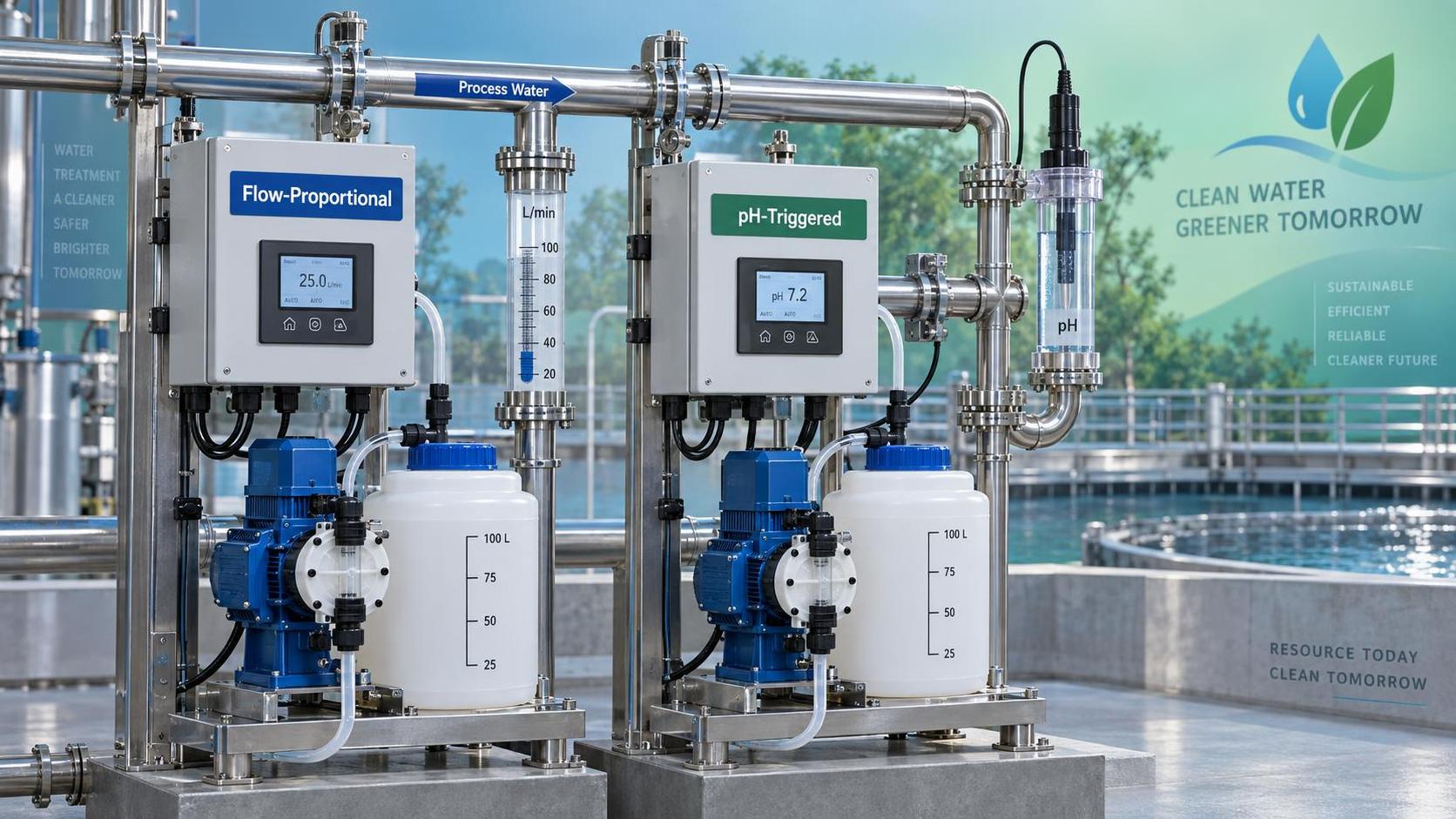
The core distinction lies not in hardware complexity, but in control philosophy: flow-proportional units dose based on volumetric flow rate alone, while pH-triggered units respond to actual effluent acidity or alkalinity in real time. If your influent pH fluctuates significantly—say, from 2.1 to 5.8 across shifts due to batch dumping in electroplating waste or variable organic loading in food processing—relying solely on flow rate means you’re dosing blind. You’ll likely under-dose during low-flow/high-acidity spikes and over-dose during high-flow/low-acidity periods. This leads to both compliance risk and unnecessary chemical consumption.
Where Flow-Proportional Units Deliver Predictability—and Where They Fall Short
Flow-proportional systems excel when influent chemistry is stable and flow variations are the dominant variable. They integrate cleanly with existing flow meters and require minimal calibration. However, their limitation is structural: they assume a fixed stoichiometric relationship between flow and required neutralizing agent. In practice, this assumption fails when influent strength changes independently of flow—common in mixed industrial sewers, storm-influenced basins, or facilities with intermittent high-strength discharges. QA teams often observe this as increasing standard deviation in final pH readings despite consistent flow meter signals. The unit isn’t malfunctioning; it’s operating exactly as designed—on incomplete data.
Why pH-Triggered Control Tightens Process Boundaries
A pH-triggered unit closes that loop by using real-time electrode feedback to adjust dosing output within seconds. It doesn’t eliminate the need for proper mixing or sensor maintenance—but it does decouple dosing accuracy from assumptions about influent composition. For EHS personnel, this translates to fewer manual interventions during shift changes, reduced risk of pH excursions into hazardous ranges (e.g., below 4.0 or above 10.5), and lower potential for reactive chemical spills during emergency adjustments. Crucially, tighter pH control also reduces scaling and fouling downstream—particularly relevant when paired with solid-liquid separation equipment like the Centrifuge (Skid-mounted, Continuous-flow, Horizontal Scroll Decanter Type), where feed consistency directly affects solids capture efficiency and bearing wear.
Practical Decision Criteria for QA and Safety Teams
You don’t need to choose one approach exclusively—many robust installations use hybrid logic. But your starting point depends on measurable process characteristics:
- Influent pH variability > ±1.5 units across normal operation? Prioritize pH-triggered control. Flow-proportional alone won’t compensate.
- Regulatory reporting requires 15-minute rolling pH averages? Flow-proportional systems rarely meet this without supplemental pH trimming loops.
- Chemical cost exceeds $12,000/month in neutralizing agents? Even a 12% reduction from tighter pH control pays back sensor and controller upgrades within 8–10 months.
- Sludge dewatering performance is inconsistent? Wide pH swings affect coagulant efficacy and floc formation—making downstream separation less predictable. Stabilizing pH upstream improves reliability of equipment like the Centrifuge (Skid-mounted, Continuous-flow, Horizontal Scroll Decanter Type).
Calibration frequency matters more than architecture: pH electrodes require daily verification with two-point buffers in high-accuracy applications, while flow meters used for proportional dosing must be checked for sensor drift and pipe coating every 30–45 days. Skipping either invalidates the entire control strategy—regardless of which type you deploy.
When Hybrid Logic Adds Operational Resilience
Some facilities implement flow-proportional base dosing with pH-triggered trim—using flow as the primary signal and pH feedback only for fine correction. This reduces electrode exposure to extreme conditions while still correcting for composition shifts. It’s especially effective where rapid pH transients occur but average acidity remains relatively constant. The key is ensuring the trim range is properly bounded: excessive override can destabilize the system during sensor faults or air bubbles on the electrode surface.
No dosing unit compensates for poor mixing, inadequate retention time, or undersized neutralization tanks. But choosing the right control logic ensures your chemical addition matches what the water actually needs—not what a flow meter guesses it needs. For teams accountable for compliance documentation, operator safety, and long-term asset integrity, that distinction isn’t technical nuance. It’s the difference between proactive process management and reactive troubleshooting.


 How Ultrapure Water Equipment Validates Compliance with SEMI F63-1118 for 28nm+ Wafer Fabrication
") Ultrapure Water Equipment for Semiconductor Manufacturing: Key Specifications Beyond Resistivity (TOC, Particle Count, Metals)
Ultrapure Water Equipment for Semiconductor Manufacturing: Key Specifications Beyond Resistivity (TOC, Particle Count, Metals) Why Flow-Proportional vs. pH-Triggered Automatic Dosing Units Deliver Different Outcomes in Wastewater Neutralization
 Automatic Dosing Unit Selection Guide: Matching Pump Type, Control Logic, and Calibration Accuracy to Your Water Matrix
 How Sodium Chlorite Generators Work: Electrochemical Generation, Feedstock Purity Requirements, and Output Stability Control
 Sodium Chlorite Generator vs. Bulk Chemical Delivery: Total Cost of Ownership for On-Site Disinfectant Production

GET A FREE QUOTE
Service Commitment: Upon receipt of your message, a dedicated representative will contact you as soon as possible to provide efficient and professional service support.
