







Understanding Process Design in Integrated Skid-Mounted Sewage Treatment Systems
Start with the process route, not the equipment shell
When procurement teams compare Integrated Skid-Mounted Domestic Sewage Treatment Equipment, the easy mistake is to focus on footprint, delivery lead time, or how compact the skid looks on a drawing. Those matter, but they do not tell you whether the process design can actually handle your wastewater, your discharge target, and your operating reality.
A better way to evaluate skid-mounted sewage treatment systems is to read them like a process package. Ask what treatment train is inside, why it was selected, what loading conditions it was designed for, and what happens when influent quality moves outside the normal range. That is where lifecycle cost, compliance risk, and operator burden are decided.
For buyers dealing with decentralized projects, temporary facilities, scattered communities, commercial compounds, or utility expansion in tight spaces, this checklist helps separate a workable design from a box that only looks integrated.
Check whether the design basis is specific to your wastewater
Before reviewing any process flow diagram, confirm the design basis. For domestic sewage, that means more than average flow. You need the influent source, daily fluctuation pattern, peak factor, expected solids load, and whether kitchen wastewater, laundry water, stormwater intrusion, or septic truck discharge will enter the system.
- Ask for the assumed influent parameters used in process sizing.
- Check whether peak hourly flow is addressed or only average daily flow.
- See if the supplier distinguishes stable residential sewage from mixed-use or highly variable site conditions.
If the design basis is generic, the skid may still run, but you are the one taking the process risk. In practice, underestimating equalization needs is one of the fastest ways to turn a neat modular package into a system that surges, foams, or misses discharge targets.
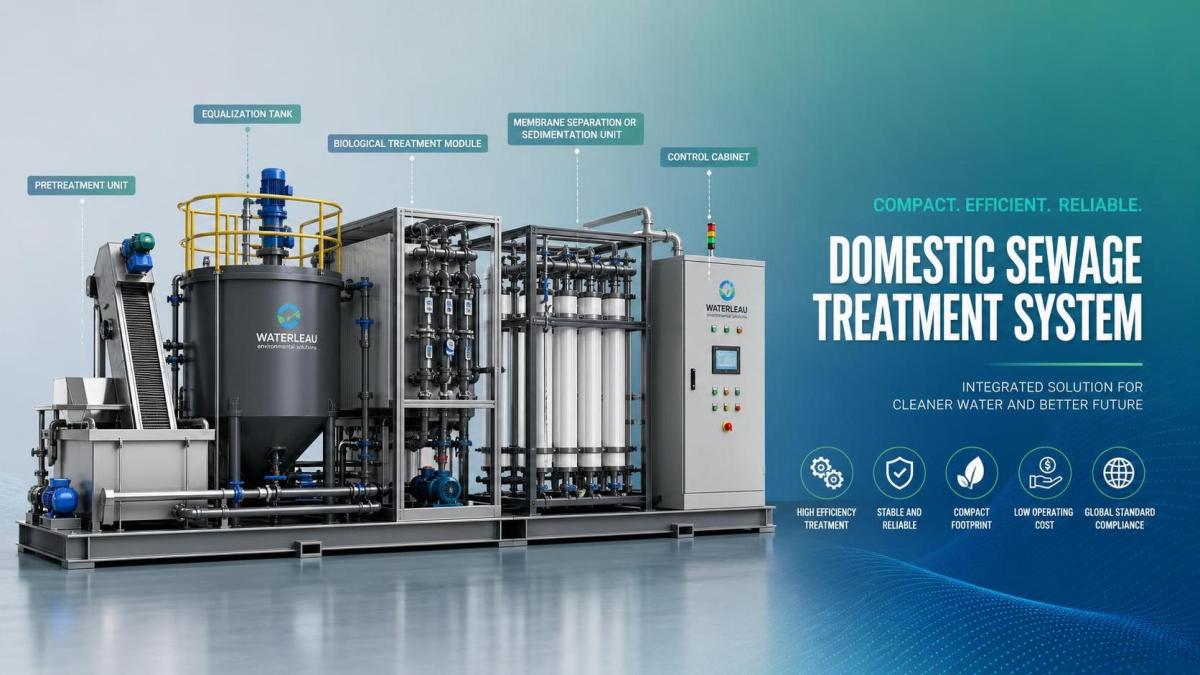
Look at the treatment sequence as a decision chain
An integrated skid should still follow sound treatment logic: pretreatment, flow balancing where needed, biological treatment, solid-liquid separation, and disinfection or polishing if required by the outlet standard or reuse purpose.
Do not accept “integrated” as an answer by itself. Ask which biological route is being used. Is it contact oxidation, MBR, MBBR, A/O, A2/O, or another combination? Each route handles loading swings, sludge production, aeration demand, and effluent stability differently. A compact MBR layout may save space, for example, but membrane maintenance, fouling control, and spare parts planning become part of the procurement decision.
A useful review question is simple: if influent worsens for three days, which unit protects downstream performance? If nobody can answer that clearly, the process train is probably underexplained.
Do not skip pretreatment and equalization just because the unit is small
Small packaged systems are often sold on simplicity, and that sometimes leads to overly optimistic pretreatment assumptions. Screens, grit control, grease management, and equalization are not optional details when the site has canteens, dormitories, staff housing, tourism peaks, or irregular occupancy.
What to check:
- Whether coarse solids removal is included in the package boundary.
- Whether grease and floating matter are expected upstream or handled inside the skid.
- Whether an equalization tank is part of the process or assumed to be civil work by others.
This is one of those points that affects both capex and responsibility split. A quotation can look attractive simply because key front-end units were excluded from scope.
Match the process to the discharge requirement, not to a brochure claim
Procurement decisions should be tied to the actual compliance target at the project location. The process design must be reviewed against the required outlet indicators and the receiving scenario, whether that means discharge to municipal sewer, direct discharge after treatment, or further reuse after polishing.
The right check is document-based: compare the supplier’s guaranteed outlet scope with the project’s required control items. Do not look only for headline terms like “meets standard.” Check which parameters are explicitly covered, under what influent assumptions, and whether nutrient removal or tertiary polishing is included when needed.
Review aeration, mixing, and sludge handling as operating cost drivers
Compact systems often win projects because they save land and shorten installation time. The tradeoff usually shows up later in energy use and maintenance frequency. Aeration is the first place to look. Check blower redundancy, control logic, air distribution method, and whether process turndown has been considered for low-load seasons.
Sludge handling deserves the same attention. Even a small sewage treatment skid produces sludge that must be withdrawn, stored, and removed without upsetting the biology. If the package description barely mentions sludge, that is a warning sign. Hidden sludge management cost has a habit of surfacing after commissioning, not before purchase.
Make sure the “integrated” promise includes controls and maintainability
A skid-mounted system should reduce field work, not push complexity into operation. Review the instrumentation list, alarm logic, local control arrangement, and access for cleaning, membrane service, pump replacement, and sampling. A layout that looks efficient on paper can be difficult to maintain once doors are open and actual technicians are working around piping and electrical cabinets.
For some projects, buyers also compare adjacent package solutions such as Small-Sized Integrated Skid-Mounted Water Purification Treatment Equipment when planning broader water infrastructure on the same site. That comparison only helps if process boundaries are kept clear: raw water purification and domestic sewage treatment solve different problems and should not be evaluated under the same performance assumptions.
Check delivery scope against the real installation path
A strong process design can still fail at procurement stage if logistics and interfaces are vague. For skid-mounted equipment, review transport dimensions, lifting plan, utility connections, drainage arrangement, odor venting, winterization needs, and commissioning responsibilities. This matters even more on remote sites or projects trying to shorten civil works.
Supplier capability matters here. Companies with long involvement in wastewater treatment engineering, project delivery, and process development usually provide clearer interface documents and more realistic startup planning than sellers focused only on equipment assembly. That engineering depth is especially valuable when site conditions force process adaptation rather than simple product selection.
Use this order when screening suppliers
In practice, the most efficient review sequence is this: confirm influent and outlet basis, verify treatment route, identify what is inside and outside the package scope, check operation-sensitive items like aeration and sludge management, then review controls, maintenance access, and delivery interfaces.
That order keeps the discussion where it belongs: on process fit and execution risk. For procurement teams, that is the difference between buying Integrated Skid-Mounted Domestic Sewage Treatment Equipment that can be commissioned smoothly and buying a compact unit that shifts uncertainty into your project schedule, operating budget, and compliance exposure.



 Small Water Purification System Performance Under Variable Turbidity: Real-World Data from Off-Grid Agricultural Communities
 When Does a Small Water Purification System Outperform Centralized Treatment? Use Cases in Disaster Response and Mining Camps
 Small Water Purification System for Remote Clinics: Power-Independent Options and WHO Drinking Water Guidelines Compliance
 Ultrapure Water Equipment ROI Calculator: Estimating Payback Period Based on Yield Improvement and Defect Reduction
 How Ultrapure Water Equipment Validates Compliance with SEMI F63-1118 for 28nm+ Wafer Fabrication
") Ultrapure Water Equipment for Semiconductor Manufacturing: Key Specifications Beyond Resistivity (TOC, Particle Count, Metals)
Ultrapure Water Equipment for Semiconductor Manufacturing: Key Specifications Beyond Resistivity (TOC, Particle Count, Metals)

GET A FREE QUOTE
Service Commitment: Upon receipt of your message, a dedicated representative will contact you as soon as possible to provide efficient and professional service support.
