







Key Technical Parameters in Small Skid-Mounted Water Purification Equipment
Start with the raw water, not the equipment brochure
When procurement teams compare compact treatment packages, the usual mistake is to start from footprint, price, or delivery time. That is backwards. For small skid-mounted systems, the key technical parameters only make sense after you pin down the incoming water quality, the target effluent, and how stable the operating conditions will be. A unit that performs well on relatively steady surface water may struggle if turbidity swings hard after rainfall, or if the feed includes oil, iron, manganese, algae, or fine suspended solids.
So the first check is simple: ask every supplier to size and configure against the same water quality basis. That means the design document should clearly state source water type, expected fluctuation, design flow, peak flow, and the treated water standard the system is expected to meet. If one quotation is based on average conditions and another is based on peak conditions, the comparison is already distorted.
Flow rate is only useful when paired with loading conditions
A nameplate flow figure looks clean in a proposal, but by itself it tells you very little. In Small-Sized Integrated Skid-Mounted Water Purification Treatment Equipment, rated capacity should always be read together with the operating assumptions behind it. Was the stated flow calculated under low turbidity water? Does it assume continuous operation, or short daily runs with storage support? Is the peak hour flow the same as the stable design flow?
For procurement review, ask for these items in one place:
- design flow and maximum instantaneous flow;
- daily operating hours assumed in sizing;
- allowable inlet water fluctuation range;
- whether backwash, sludge discharge, and downtime reduce net output.
A compact skid can appear adequate on paper yet fail the site requirement once you account for wash water consumption and intermittent operation. That gap causes real trouble during acceptance.
Watch the process route behind the skid
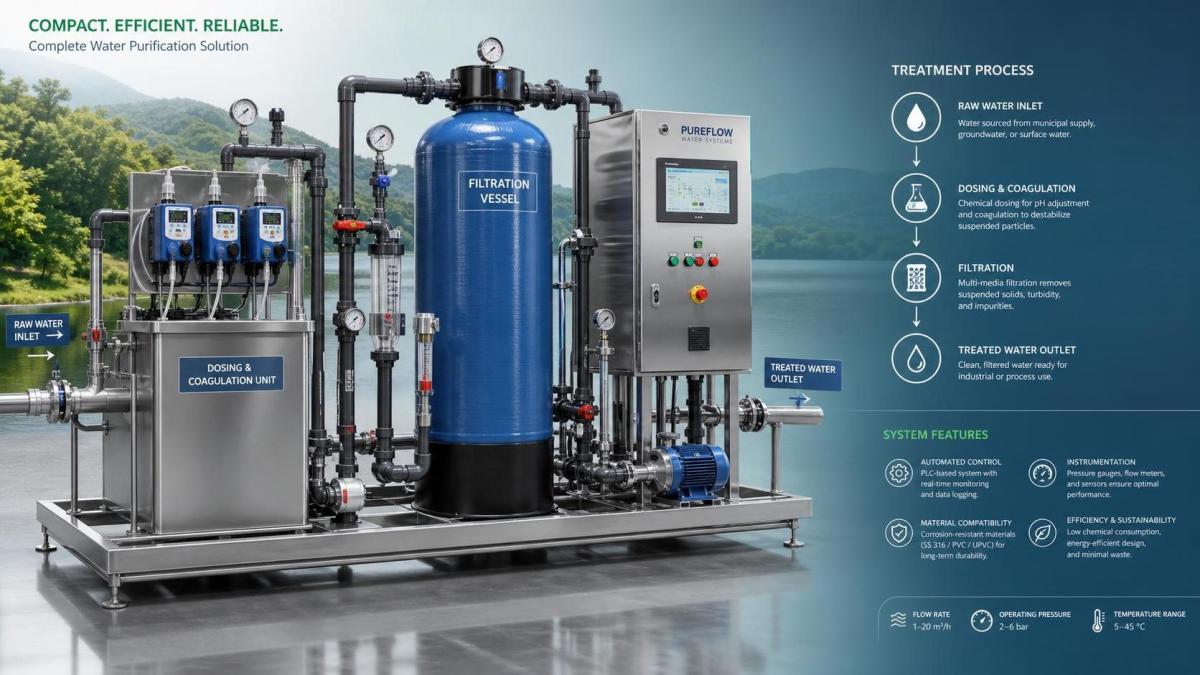
Small packaged systems are often judged as if the skid itself were the process. It is not. The real question is whether the treatment train matches the water problem. Depending on the application, the skid may combine dosing, mixing, flocculation, sedimentation, filtration, and disinfection in different ways. Procurement teams do not need to redesign the process, but they do need to check whether each major step has a clear purpose.
If the supplier cannot explain why a given unit operation is included, or what feedwater condition would make it insufficient, that is a warning sign. This matters especially in municipal, industrial, and ecological water treatment projects where water quality can shift by season, production cycle, or weather event.
A practical review table
Do not skip material and corrosion review
In small packaged systems, buyers often focus on the visible frame and piping layout, while the more important issue is material compatibility with the actual water chemistry and cleaning regime. Carbon steel, stainless steel, FRP, PVC, and lined components all have their place, but they are not interchangeable once chloride level, oxidant use, pH range, and outdoor exposure are considered.
Ask for the material list by wetted component, not just a one-line statement about the skid body. A proposal that says “stainless steel equipment” without identifying where that steel is used is too vague for technical comparison. This becomes even more important when the package includes disinfection sections or interfaces with oxidizing chemicals.
Automation level should match the site reality
Compact water purification skids are often sold on the promise of easy operation. Sometimes that is true. Sometimes it only means the PLC screen looks tidy. For procurement, the better question is whether the control scheme matches the staffing level and utility conditions at the site.
Check the instrument list and ask what each instrument actually controls. Level switches, flow measurement, pressure monitoring, turbidity feedback, and dosing interlocks should all have a stated function. If the site has unstable power or limited operators, fault alarms and manual override logic matter more than decorative automation features. A compact skid that cannot be sensibly operated in local conditions will create service calls from day one.
One reasonable reference point during comparison is the documentation quality around Small-Sized Integrated Skid-Mounted Water Purification Treatment Equipment. Not because a link proves technical fitness, but because good suppliers usually present process boundaries, interfaces, and operating requirements clearly enough for a buyer to evaluate risk before purchase.
Utilities and interfaces deserve their own line-by-line check
A skid-mounted package is compact, not self-sufficient. Many procurement problems show up at installation because utility conditions were treated as minor details. They are not.
- Power supply: voltage, frequency, installed load, and startup load.
- Feed water pressure: whether the skid needs a stable inlet pressure or a separate feed pump.
- Drainage: backwash water, sludge discharge, overflow, and emergency drain path.
- Chemical support: storage, dosing tank arrangement, and refill access.
- Installation envelope: transport dimensions, lifting points, maintenance clearance, and access doors.
These are not secondary commercial details. They directly affect whether the unit can be installed on time and commissioned without redesign.
Ask how the unit will be cleaned, washed, and maintained
Procurement teams sometimes compare only the normal operating mode. That misses a big part of lifecycle usability. Filters foul. Dosing lines block. Instruments drift. A practical supplier should be able to explain backwash sequence, consumable replacement points, routine maintenance intervals, and what level of technician is needed for service.
If that information is vague, expect hidden O&M burden later. Compact equipment is supposed to reduce site complexity; it should not push maintenance complexity into undocumented manual work.
Documentation quality is a technical parameter in disguise
For buyers dealing with multiple quotations, the cleanest way to separate serious engineering from sales packaging is to review the document set. A technically credible offer should include process description, P&ID or equivalent flow diagram, equipment list, utility list, control description, interface conditions, and commissioning scope. If the supplier has experience across wastewater treatment and broader environmental engineering fields, that often shows up here: the documents define boundaries clearly and do not leave basic operating assumptions unstated.
That is particularly relevant when evaluating Small-Sized Integrated Skid-Mounted Water Purification Treatment Equipment for projects where civil work, utility support, and downstream handling all need coordination. Poor documentation usually means poor handover later.
How to use this checklist in an actual bid comparison
Use a simple order. Lock the design basis first. Then compare process route, flow assumptions, materials, automation, utility interfaces, and maintenance method. Only after that should price become decisive. If two suppliers offer very different process assumptions, ask them to restate the proposal on the same inlet water and output basis before you compare cost.
That approach keeps the decision grounded in technical fit instead of presentation quality. In compact water treatment procurement, the safest purchase is usually the one with the clearest design boundary, the most transparent operating assumptions, and the fewest hidden dependencies during installation and operation.



 Small Water Purification System Performance Under Variable Turbidity: Real-World Data from Off-Grid Agricultural Communities
 When Does a Small Water Purification System Outperform Centralized Treatment? Use Cases in Disaster Response and Mining Camps
 Small Water Purification System for Remote Clinics: Power-Independent Options and WHO Drinking Water Guidelines Compliance
 Ultrapure Water Equipment ROI Calculator: Estimating Payback Period Based on Yield Improvement and Defect Reduction
 How Ultrapure Water Equipment Validates Compliance with SEMI F63-1118 for 28nm+ Wafer Fabrication
") Ultrapure Water Equipment for Semiconductor Manufacturing: Key Specifications Beyond Resistivity (TOC, Particle Count, Metals)
Ultrapure Water Equipment for Semiconductor Manufacturing: Key Specifications Beyond Resistivity (TOC, Particle Count, Metals)

GET A FREE QUOTE
Service Commitment: Upon receipt of your message, a dedicated representative will contact you as soon as possible to provide efficient and professional service support.
