







How to Size Skid-mounted Single-stage Drinking Pure Water Equipment for Daily Output
Start from the required net daily water volume, then work backward through operating hours, membrane recovery, pretreatment losses, and cleaning downtime. For Skid-mounted Single-stage Drinking Pure Water Equipment, the common sizing mistake is to match membrane capacity only to nominal daily output. That usually underestimates the feed flow, ignores seasonal raw water shifts, and leaves no margin for pressure loss, fouling, or wash cycles.
A practical sizing path begins with the actual finished water demand per day and the number of stable operating hours available. If the unit must deliver water continuously across a full day, the hourly permeate target can stay relatively low. If the site only allows operation during certain shifts, or if tank storage is intentionally limited, the same daily output has to be produced in fewer hours, which raises instantaneous permeate flow and usually changes pump, membrane, and piping selection. A 24-hour design and a 12-hour design for the same daily total are not equivalent machines.
Convert daily output into design flow
The base calculation is straightforward: daily finished water demand divided by effective operating hours gives required permeate flow. The important part is defining effective hours honestly. Scheduled flushing, startup stabilization, conductivity diversion at startup, and periodic chemical cleaning all reduce productive time. If the water quality specification requires low conductivity from the first storage point onward, startup discharge may need to be treated as a real loss rather than an internal recycle.
After permeate flow is defined, feed flow should be calculated from the expected recovery rate of the single-stage reverse osmosis or similar pure water process. Recovery cannot be chosen from brochure values alone. It depends on raw water total dissolved solids, hardness, silica tendency, temperature, pretreatment quality, and the allowable concentrate scaling risk. If raw water fluctuates or contains hardness spikes, a conservative recovery assumption is usually safer than forcing a compact skid into high recovery service.
For example, if the target is a certain permeate flow and the recovery is set lower to protect membrane life, feed flow rises, concentrate flow rises, and pretreatment equipment may need to be upsized as well. That affects cartridge filter loading, antiscalant dosing points if used, inlet pump sizing, reject piping velocity, and drain handling.
Raw water quality changes the sizing more than the frame size
Two skid-mounted units with identical nominal output can behave very differently depending on source water. Municipal tap water, softened groundwater, low-turbidity surface water after clarification, and reused process water each create different constraints. For drinking pure water applications, the single-stage configuration usually assumes that pretreatment is stable enough to protect the membranes from suspended solids, oxidants, hardness scaling, and organic fouling. If that assumption is weak, the apparent savings of a simpler skid may disappear in operation.
Several raw water parameters often drive the decision:
- Hardness and alkalinity determine scaling tendency. High values may require softening, antiscalant, or lower recovery.
- Free chlorine can damage polyamide membranes, so dechlorination media or chemical reduction may be necessary before the membrane train.
- Turbidity and silt density behavior affect cartridge replacement frequency and pressure drop stability.
- Temperature shifts change membrane flux. Colder water can reduce actual permeate production enough to make a nominal design miss its daily target.
- Silica, iron, manganese, and organics may not always be severe, but when present they often control cleaning frequency and long-term flux decline.
Because of that, sizing Skid-mounted Single-stage Drinking Pure Water Equipment should include the worst reasonable raw water condition, not only the average lab sample. If winter water temperature is much lower than summer temperature, membrane area may need to be increased or operating hours extended. If the skid has no room for future membrane expansion, that early decision becomes difficult to correct later.
Membrane array, pressure vessel count, and flux selection
Once feed flow and recovery are estimated, membrane array design becomes the next sizing layer. The choice is not only how many membrane elements are needed, but also what flux each element is expected to run at. A high-flux design may reduce the number of pressure vessels on paper, yet it can increase fouling rate, raise cleaning frequency, and make product quality more sensitive to feed variation. A lower flux design usually occupies more skid space, but it tends to be calmer in operation.
For skid-mounted systems, mechanical packaging matters. Pressure vessels, high-pressure pump, cartridge housing, valves, conductivity instruments, flowmeters, and chemical dosing points all need service access. A design that technically fits on a frame can still be poor if membrane replacement requires disassembling adjacent piping or if instrument calibration points are blocked by the support structure.
Material selection should follow the water chemistry and installation environment. Stainless steel is often chosen for hygienic sections and corrosion resistance, but grade selection still matters. If the room atmosphere is aggressive or chloride exposure is elevated, material review becomes more important. UPVC, CPVC, or FRP may appear in pretreatment or concentrate piping depending on pressure and chemical compatibility. Gasket and O-ring compatibility should also be checked against cleaning chemicals and disinfectants.
Pretreatment defines whether the single-stage skid remains a pure water unit or becomes a cleaning project
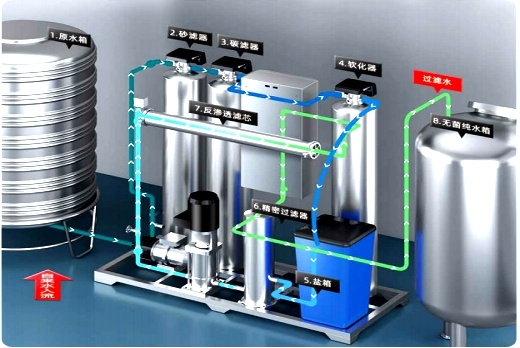
Single-stage drinking pure water equipment is often evaluated as a compact integrated skid, but pretreatment should be treated as part of the same capacity decision. Multimedia filtration, activated carbon, softening, precision cartridge filtration, and dosing systems are not decorative accessories. They determine whether the membrane section can actually sustain its design output.
In some projects, pretreatment may be independent and upstream. In others, the skid may sit after an external solids-removal process. That is one reason adjacent modular technologies sometimes appear in the same evaluation set, such as Rare Earth Disk Separation and Purification Skid-Mounted Equipment / Magnetic Coagulation Skid-Mounted Equipment, especially where source water quality is unstable and suspended matter control needs to be strengthened before fine purification. The sizing logic remains the same: membrane equipment should only be credited with the capacity that the upstream water condition can realistically support.
Activated carbon sizing is frequently underestimated where residual oxidants vary. Once carbon approaches exhaustion, membrane damage may happen quickly. Cartridge filters are also sometimes sized only by connection diameter rather than dirt-holding behavior and acceptable differential pressure. That creates a maintenance burden and can reduce pump suction stability.
Storage and distribution affect skid size indirectly
Daily output is rarely consumed at a perfectly constant rate. If end use has hourly peaks, either the skid must ramp to follow them or the storage tank must absorb them. A compact skid designed for average flow may still be correct if the pure water tank is large enough and level controls are set properly. If storage is intentionally small for hygiene reasons, the skid may need variable-frequency control, better turndown behavior, and tighter instrumentation.
This is also where conductivity criteria matter. If product water is recirculated in a loop, tank material, vent filtration, and internal finish may matter as much as the membrane itself. A well-sized skid can still miss practical water quality targets if the downstream tank and loop allow contamination, temperature rise, or stagnant zones.
Transport, installation, and utility constraints
Skid-mounted equipment is often selected to reduce field assembly, but transport limits still shape capacity. Frame width, lifting points, center of gravity, and road transport restrictions can force the system into one skid or multiple skids. When output increases beyond a certain point, splitting pretreatment and membrane sections may be easier than forcing all functions onto one transportable base.
Site utilities should be checked early. High-pressure pump demand, pretreatment backwash water, compressed air for valve actuation if used, chemical dosing space, floor drain capacity, and reject discharge routing all affect whether the chosen output can be supported. A skid that meets process calculations but exceeds the available electrical feeder or floor loading is undersized in practical engineering terms because it cannot operate as intended.
Installation details also influence maintainability. Leave room for membrane pulling length, cartridge housing opening, chemical tank refill access, and safe routing of CIP hoses if clean-in-place is included. If the project expects frequent relocation or phased expansion, modular pipe connections and instrument junction layout deserve attention during sizing, not after purchase.
Common judgment errors during selection
- Using peak membrane catalog flow as if it were stable daily production under real feed temperature and fouling conditions.
- Assuming the same recovery for all raw waters, even when hardness, silica, or seasonal conductivity changes are obvious.
- Ignoring downtime for flushing and cleaning, then discovering that the unit cannot reach the nominal daily target without extending runtime.
- Specifying a compact skid footprint first and forcing the process into that envelope afterward.
- Comparing units only by permeate output while overlooking feed pump head, pretreatment depth, instrument completeness, and maintenance access.
Where upstream clarification is part of a broader treatment train, the interface between solids removal and pure water production should be reviewed carefully. In some layouts, technologies such as Rare Earth Disk Separation and Purification Skid-Mounted Equipment / Magnetic Coagulation Skid-Mounted Equipment may sit outside the pure water skid yet still affect membrane sizing by changing turbidity stability and pretreatment loading.
A sound daily output selection usually comes down to three numbers that agree with each other: the net water demand, the realistic effective operating hours, and the sustainable recovery under the actual raw water envelope. When those are defined first, the skid dimensions, membrane count, pump duty, and pretreatment scope tend to settle into a design that is easier to operate and less likely to lose capacity after commissioning.


 How to Size Skid-mounted Single-stage Drinking Pure Water Equipment for Daily Output
 Which Standards Should Skid-mounted Single-stage Drinking Pure Water Equipment Meet?
 How Modular Skid-mounted Single-stage Drinking Pure Water Equipment Is Shaping Small Water Projects
 Which Standards and Certifications Matter for Large-Scale Integrated Skid-Mounted Water Purification Treatment Equipment?
 Key Process Units Inside Large-Scale Integrated Skid-Mounted Water Purification Treatment Equipment Explained
 Common Startup Failures in Large-Scale Integrated Skid-Mounted Water Purification Treatment Equipment and How to Fix Them
GET A FREE QUOTE
Service Commitment: Upon receipt of your message, a dedicated representative will contact you as soon as possible to provide efficient and professional service support.
