







How Does Small-Sized Integrated Skid-Mounted Water Purification Equipment Work?
Why do companies choose a small skid-mounted unit instead of a traditional water treatment setup?
In most cases, the appeal is simple: less construction work, faster installation, and a more predictable startup. Small-Sized Integrated Skid-Mounted Water Purification Treatment Equipment combines the main treatment steps on a factory-assembled frame, so the system arrives as a compact module rather than a loose collection of tanks, pumps, valves, and controls that need extensive site assembly.
For a decision-maker, that changes the project risk profile. You are usually dealing with a smaller footprint, shorter commissioning time, and fewer on-site coordination problems. This matters when the site has limited space, when utilities must be restored quickly, or when expansion needs to happen in stages instead of through one large civil project.
So how does the equipment actually work?
The working principle is not mysterious. The skid-mounted format changes how the system is packaged, not the basic logic of water purification. Water enters the unit, passes through a sequence of treatment steps, and leaves at a quality level defined by the intended use.
A typical process train may include:
- screening or basic pretreatment to remove larger solids
- coagulation or flocculation, where fine particles are encouraged to gather into larger flocs
- sedimentation or clarification to separate those solids from water
- filtration to polish the water and remove remaining suspended matter
- disinfection, depending on the final application
Not every unit uses every step, and the order can vary by design. The point is that the skid integrates these functions into one coordinated package with pumps, piping, instrumentation, and a control system already matched to each other.
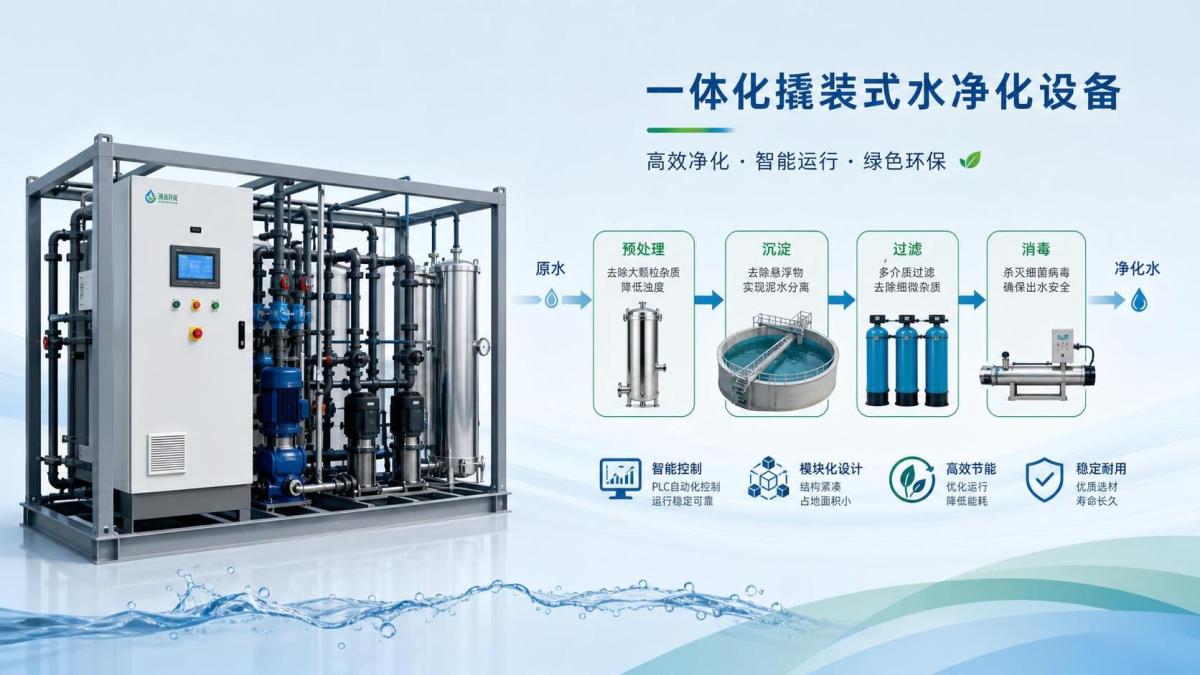
What does “integrated” really mean in day-to-day operation?
It means the treatment process is engineered as a whole, not bought piece by piece and stitched together later. That affects more than layout. It affects control logic, dosing stability, hydraulic balance, alarm management, and maintenance access.
For example, if filtration capacity and dosing response are mismatched, water quality becomes unstable even when each individual component looks acceptable on paper. An integrated skid reduces that kind of mismatch because the main components are selected to work together from the beginning.
What kinds of water can this equipment handle?
That depends on the actual process configuration, not the skid format itself. A small skid-mounted system can be designed for different duties, such as domestic wastewater polishing, industrial process water pretreatment, or decentralized purification needs. What matters is the incoming water quality and the required outlet standard.
Before evaluating any unit, check these four items:
- Source water characteristics: solids, organics, odor, color, and flow fluctuation
- Target water use: discharge, reuse, process water, or further treatment feed
- Operating pattern: continuous, intermittent, seasonal, or peak-load driven
- Site conditions: footprint, power supply, chemical storage, drainage, and operator availability
This is where many purchasing mistakes start. Buyers sometimes compare only capacity and price, while the real issue is whether the treatment route fits the water quality variation they will face on-site.
Is a compact skid system only for small projects?
No. It is small in physical packaging, but that does not automatically mean low strategic value. These systems are often used where modularity matters: remote facilities, phased expansion, temporary production support, emergency replacement, or sites where civil works are difficult.
For some organizations, a small unit is also a practical first-stage deployment. It lets the operator validate process stability, maintenance needs, and water quality response before scaling to a larger treatment arrangement.
What should an enterprise decision-maker evaluate before buying?
Start with process fit, then move to delivery and operations. A unit that looks efficient in a brochure can still create trouble if the dosing system is hard to calibrate, if spare parts are too specialized, or if operators cannot easily understand the control interface.
If you are reviewing packaged options related to domestic wastewater treatment, one example in this category is Integrated Skid-Mounted Domestic Sewage Treatment Equipment. The useful question is not whether the packaging is modern, but whether the process path matches your water and operating conditions.
Where do compact skid-mounted systems usually fail in practice?
Most failures are not caused by the skid concept itself. They usually come from one of three problems: poor influent assumptions, inadequate pretreatment, or unrealistic operating expectations.
A common example is feeding water with higher solids or stronger load swings than the system was designed for. Another is underestimating sludge handling, backwashing needs, chemical replenishment, or operator response time. Compact equipment saves space, but it does not remove the need for process discipline.
How much operator involvement does it need?
Usually less than a fully site-built system, but not zero. Automated controls can manage routine sequences such as pump switching, dosing coordination, and alarm prompts. Even so, someone still needs to check chemical levels, verify sensor readings, inspect filters or separation performance, and respond when influent conditions change.
That matters for budgeting. A skid-mounted unit should be treated as a simplified operating asset, not a self-running box.
Does skid-mounted design reduce total project cost?
Often it reduces project complexity first, and cost second. Savings may come from shorter installation time, reduced civil work, and fewer on-site assembly issues. But total cost still depends on chemical consumption, energy use, consumables, sludge disposal, maintenance frequency, and how often the unit operates away from design conditions.
This is why a low purchase price can be misleading. A better comparison is lifecycle logic: what the system needs to keep meeting water targets over time, under the actual operating pattern of your site.
What documents should be checked before approval?
Ask for the process flow description, equipment list, control scope, utility requirements, layout or footprint drawing, and commissioning boundaries. These documents tell you where the supplier’s responsibility ends and where your internal team or contractor must take over.
Also check whether the proposal clearly states the design basis for influent conditions and expected treated water quality. If that basis is vague, later disputes about performance become much harder to resolve.
What is the most practical way to judge whether this equipment fits your site?
Use one rule: match water reality to process reality. If the water source is variable, dirty, or operationally unstable, the skid must be designed for that, not for ideal lab conditions. If your site has limited operators, limited space, and pressure to install quickly, the integrated format becomes more valuable.
For enterprise buyers, the best next step is not to chase the most compact package. It is to confirm the influent profile, define the outlet requirement, and review whether the selected Small-Sized Integrated Skid-Mounted Water Purification Treatment Equipment can keep performing when real operating conditions stop being neat and predictable.



 Small Water Purification System Performance Under Variable Turbidity: Real-World Data from Off-Grid Agricultural Communities
 When Does a Small Water Purification System Outperform Centralized Treatment? Use Cases in Disaster Response and Mining Camps
 Small Water Purification System for Remote Clinics: Power-Independent Options and WHO Drinking Water Guidelines Compliance
 Ultrapure Water Equipment ROI Calculator: Estimating Payback Period Based on Yield Improvement and Defect Reduction
 How Ultrapure Water Equipment Validates Compliance with SEMI F63-1118 for 28nm+ Wafer Fabrication
") Ultrapure Water Equipment for Semiconductor Manufacturing: Key Specifications Beyond Resistivity (TOC, Particle Count, Metals)
Ultrapure Water Equipment for Semiconductor Manufacturing: Key Specifications Beyond Resistivity (TOC, Particle Count, Metals)
GET A FREE QUOTE
Service Commitment: Upon receipt of your message, a dedicated representative will contact you as soon as possible to provide efficient and professional service support.
