







Before You Buy: 7 Checks for Small-Sized Integrated Skid-Mounted Water Units
Start with the water and the duty, not the equipment name
A lot of buying mistakes happen before a supplier even sends a quotation. The phrase Small-Sized Integrated Skid-Mounted Water Purification Treatment Equipment sounds precise, but it still covers very different use cases: raw water polishing, process water support, temporary site supply, pretreatment ahead of reuse, or compact treatment for remote facilities. If your RFQ only says “small integrated unit,” you will get prices that look comparable and proposals that are not.
Write down three things first: inlet water source, target effluent or reuse purpose, and daily operating pattern. Intermittent operation, seasonal water quality swings, and operator availability all change what kind of skid makes sense. Procurement teams that skip this step often end up comparing flow rate only, which is rarely the cost driver over the life of the unit.
Check 1: What exactly must the unit remove?
Ask for the supplier’s process basis against your actual contaminants, not a generic process description. Turbidity, suspended solids, iron, manganese, organics, odor, algae risk, and disinfection needs push the design in different directions. A compact skid that works well on one source may struggle badly on another if the water quality profile is wrong for the process train.
A useful procurement question is simple: Which inlet water conditions is this proposal designed around, and what happens when those conditions drift? Good suppliers will answer with design assumptions and operating boundaries. Weak proposals hide behind broad claims like “stable treatment effect” without tying them to actual water conditions.
Check 2: Compare throughput in real operating hours
Nameplate capacity can be misleading. For procurement, what matters is delivered output after backwashing, chemical preparation, cleaning, shift patterns, and downtime. If one unit is priced lower but needs more frequent intervention, the apparent savings disappear quickly.
When you review offers, put these points side by side:
- Rated flow and recommended operating window
- Whether the unit is designed for continuous or batch-style operation
- Backwash or cleaning frequency
- Expected operator touchpoints per day or per week
- Utility needs: power, water for cleaning, and chemical dosing support
This is where total cost starts to separate serious designs from cheap assemblies.
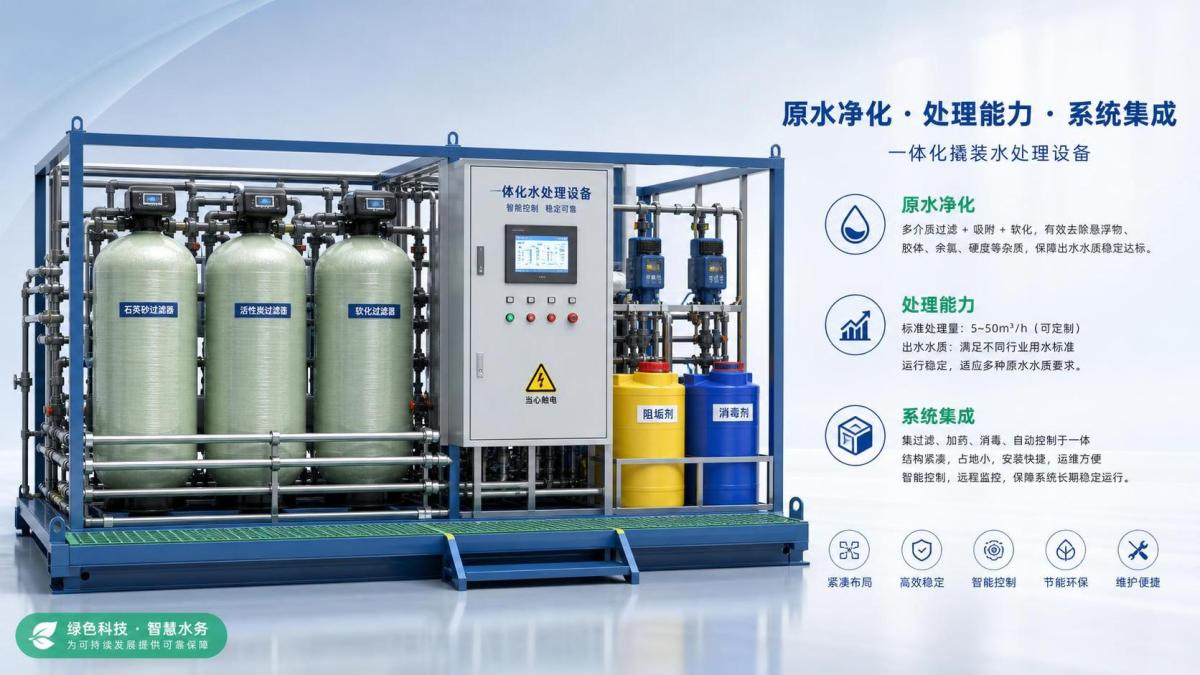
Check 3: Footprint is not just floor area
Buyers usually ask for dimensions. They should also ask how the skid is supposed to live on site. A compact footprint on paper can still be awkward in practice if there is no room for maintenance access, chemical handling, lifting, drainage, or instrument calibration.
For small skid-mounted systems, I would always want a basic layout showing service clearance, connection points, and where routine work happens. If filter media replacement or pump servicing requires dismantling half the frame, the “small-size” advantage is mostly cosmetic.
Check 4: Look closely at the disinfection section
In many water projects, disinfection is where procurement risk gets underestimated. The question is not only whether disinfection is included, but how it is generated, dosed, stored, and integrated with the rest of the skid. For some applications, buyers may also review related chlorine dioxide preparation options such as W3 type (comprehensive method) chlorine dioxide preparation technology when the wider treatment scheme calls for that route.
The key point is practical: if the water unit depends on a disinfection step, your team should check chemical supply logic, dosing control, and operator handling requirements at the same time as the skid itself. Too many procurement packages treat this as a separate afterthought, then discover integration gaps during installation or commissioning.
Check 5: Ask what the supplier will deliver beyond the frame
A skid is never just steel, piping, and instruments. The buying decision changes when you clarify scope. Does the quotation include control logic, local panel, commissioning support, operating documents, spare parts, and operator training? Or are you pricing a partial package that will need more engineering work later?
This matters even more in environmental and energy projects where site conditions can be tight and schedules unforgiving. Companies with real engineering depth tend to discuss interfaces early: influent variability, downstream tie-ins, drainage, power supply, and startup sequence. That is often a better sign than a polished brochure.
Check 6: Review compliance documents by application, not by slogan
Do not settle for broad statements like “meets industry standards.” Ask which project documents define the required output and what part of the supplier package addresses them. The right file to check depends on where the unit will be used: municipal support, industrial process water, wastewater-related reuse, or another application with its own owner specifications.
A practical review table helps:
Check 7: Test the supplier’s problem-solving depth
For compact treatment systems, supplier capability is not a soft factor. It directly affects project risk. A vendor with long experience in wastewater treatment, engineering integration, and related disinfection technologies will usually ask better questions during pre-sale review. That matters because small units often get deployed in messy real-world conditions, not ideal lab assumptions.
One fast way to judge this is to watch how they handle edge cases. Ask what changes if the raw water worsens, if operators are not full-time, if site utilities fluctuate, or if the skid must be expanded later. Clear technical answers are worth more than a low first quote.
What a solid buying sequence looks like
If you are sourcing Small-Sized Integrated Skid-Mounted Water Purification Treatment Equipment for a cost-sensitive project, keep the process disciplined. Define the water and duty first. Then compare proposals on real output, operating burden, and site fit. After that, review disinfection integration, scope boundaries, and the supplier’s engineering depth. Price should come after those checks, not before them.
The buyers who avoid trouble are usually the ones who turn vague equipment comparisons into a document-based review: design basis, layout, utilities, controls, startup scope, and operating assumptions. Once those are on the table, the right purchase decision becomes much easier to defend internally.


 When Does a Small Water Purification System Outperform Centralized Treatment? Use Cases in Disaster Response and Mining Camps
 Small Water Purification System for Remote Clinics: Power-Independent Options and WHO Drinking Water Guidelines Compliance
 Ultrapure Water Equipment ROI Calculator: Estimating Payback Period Based on Yield Improvement and Defect Reduction
 How Ultrapure Water Equipment Validates Compliance with SEMI F63-1118 for 28nm+ Wafer Fabrication
") Ultrapure Water Equipment for Semiconductor Manufacturing: Key Specifications Beyond Resistivity (TOC, Particle Count, Metals)
Ultrapure Water Equipment for Semiconductor Manufacturing: Key Specifications Beyond Resistivity (TOC, Particle Count, Metals) Why Flow-Proportional vs. pH-Triggered Automatic Dosing Units Deliver Different Outcomes in Wastewater Neutralization
GET A FREE QUOTE
Service Commitment: Upon receipt of your message, a dedicated representative will contact you as soon as possible to provide efficient and professional service support.
