







W1 Type (Low Negative Pressure) Chlorine Dioxide Preparation Technology: Comprehensive Solutions for Modern Water Treatment
1. Introduction & Global Water Treatment Challenges
Modern water treatment infrastructure faces a complex engineering challenge: eliminating resilient pathogens like Cryptosporidium while strictly controlling harmful disinfection by-products (DBPs). Traditional positive-pressure dosing systems and raw gas chlorination increasingly fail to meet modern safety and environmental mandates.
To bridge this gap, W1 type (low negative pressure) chlorine dioxide preparation technology has emerged as a premier industrial solution. By utilizing a highly selective advanced oxidation biocide under a continuous vacuum, this system balances biological efficacy with strict operational safety.
Before diving into engineering configurations, it is vital to establish a clear baseline. For a foundational engineering overview of this process, see our primary guide: [What is W1 Type (Low Negative Pressure) Chlorine Dioxide Preparation Technology? A Technical Definition].
2. Core Technology Mechanism & Safety Profile
The foundational value of the W1 system lies in its liquid-driven vacuum loop. Instead of using high-pressure metering pumps to force chemicals into a volatile environment, a high-velocity water ejector creates a continuous, controlled vacuum (-0.04 to -0.07MPa) inside the reaction chamber.
This vacuum safely draws raw precursors directly into the reaction matrix. To study how this negative pressure configuration prevents toxic chemical escapes during structural failures, read our dedicated safety brief: [The Science of Zero-Leakage: Safety Mechanisms of W1 Type (Low Negative Pressure) Chlorine Dioxide Preparation Technology].
Technical Parameters & Technology Comparison
3. Equipment Classification & Structural Specifications
To meet diverse industrial scales, W1 systems are classified by hourly mass output, ranging from micro-dosing series (50g/h}) up to large municipal platforms (10 kg/h ). For a detailed breakdown of equipment sizing matrices, consult: [System Classifications and Capacity Scaling in W1 Type (Low Negative Pressure) Chlorine Dioxide Preparation Technology].
Beyond pure capacity sizing, these systems are built with modular versatility to match existing plant spaces. Engineers can choose between open skid frames or fully enclosed housings. To evaluate the architectural tradeoffs for your facility layout, download our comparison manual: [Skid-Mounted vs. Containerized: Structural Configurations of W1 Type (Low Negative Pressure) Chlorine Dioxide Preparation Technology].
4. Key Application Scenarios & Selection Guide
Target Sectors and Dosing Parameters
Municipal Waterworks (0.2 - 1.0mg/L): Eliminates biological pathogens without altering water taste or generating chlorinated by-products. For verified field data, review our municipal whitepaper: [Applying W1 Type (Low Negative Pressure) Chlorine Dioxide Preparation Technology in Municipal Tap Water Disinfection].
Hospital Wastewater (5.0 - 20.0mg/L): Neutralizes highly resilient antibiotic-resistant bacteria and complex viral loads before discharge. For compliance protocols, read: [Meeting Bio-Safety Standards: W1 Type (Low Negative Pressure) Chlorine Dioxide Preparation Technology for Hospital Wastewater].
Industrial Cooling Towers (0.5 - 2.0mg/L): Removes biological slime sheets and controls Legionella risks to maintain thermal efficiency. For cooling loop optimization strategies, see: [Biofilm Control in Cooling Towers Using W1 Type (Low Negative Pressure) Chlorine Dioxide Preparation Technology].
5. Financial Efficiency & System Automation
While the initial capital expense for automated vacuum systems is higher than basic positive-pressure setups, the operational savings ensure rapid cost recovery. A conversion yield exceeding 95% significantly cuts raw chemical usage. To run the cost equations for your plant, read our ROI report: [Cost-Effective Water Treatment: OPEX Reduction via W1 Type (Low Negative Pressure) Chlorine Dioxide Preparation Technology].
CHEMICAL CONVERSION YIELD COMPARISON:
=========================================
W1 Type Vacuum System:        [█████████████████████] 95%+ Yield (Lower OPEX)
Traditional Positive Pressure:[████████████████░░░░░] 75%-82% Yield (High Waste)
=========================================
Furthermore, advanced system integration reduces manual oversight. Modern W1 units feature integrated Siemens PLC control for automated dosing adjustments. For automation layouts, check: [Smart Disinfection Solutions: PLC Integration in W1 Type (Low Negative Pressure) Chlorine Dioxide Preparation Technology].
6. Long-Term Maintenance & Asset Lifespan
Premium W1 units feature reactors milled from specialized titanium alloys and PVDF polymers, ensuring a core lifecycle of over 10 years. However, maintaining the integrity of the vacuum seal is critical for long-term safety. For step-by-step guidance on sensor calibration and component care, download our checklist: [Long-Term Asset Maintenance Guide for W1 Type (Low Negative Pressure) Chlorine Dioxide Preparation Technology Systems].
Conclusion
The transition toward high-safety, high-efficiency water infrastructure makes legacy pressurized chemical dosing obsolete. The W1 type (low negative pressure) chlorine dioxide preparation technology represents the future of water treatment, combining high chemical conversion yields with a safe, vacuum-driven design. Integrating this technology protects your staff, ensures regulatory compliance, and minimizes long-term chemical waste.
Frequently Asked Questions
FAQ 1: What is the main safety advantage of a low negative pressure chlorine dioxide generator compared to traditional positive pressure systems?
A traditional positive pressure system forces chemicals outward under pressure; a leak or block sprays toxic gas or acid into the workspace. The W1 low negative pressure system operates entirely under a vacuum (-0.04 to -0.07MP). If a seal fails, ambient air is drawn safely inward into the reactor, while an automatic pressure switch instantly halts all chemical suction.
FAQ 2: How does the W1 Type system optimize the chemical conversion rate of sodium chlorate/chlorite?
The system utilizes a multi-stage vacuum reaction column that enhances gas desorption and optimizes chemical mixing. By eliminating the pulsing chemical feeds typical of positive-pressure pumps, the vacuum environment maintains a highly accurate, continuous stoichiometric balance, consistently delivering a chemical conversion rate ge 95%
FAQ 3: What international certifications should B2B buyers look for when importing W1 chlorine dioxide preparation systems?
Buyers should verify CE Marking or UL/CSA compliance for electrical cabinets and PLC systems. For pressure-retaining components and vacuum structural integrity, compliance with ASME Section VIII or the European PED is recommended. Lastly, internal fluid-path materials should carry NSF/ANSI Standard 61 clearance to guarantee no trace contaminants enter drinking water.



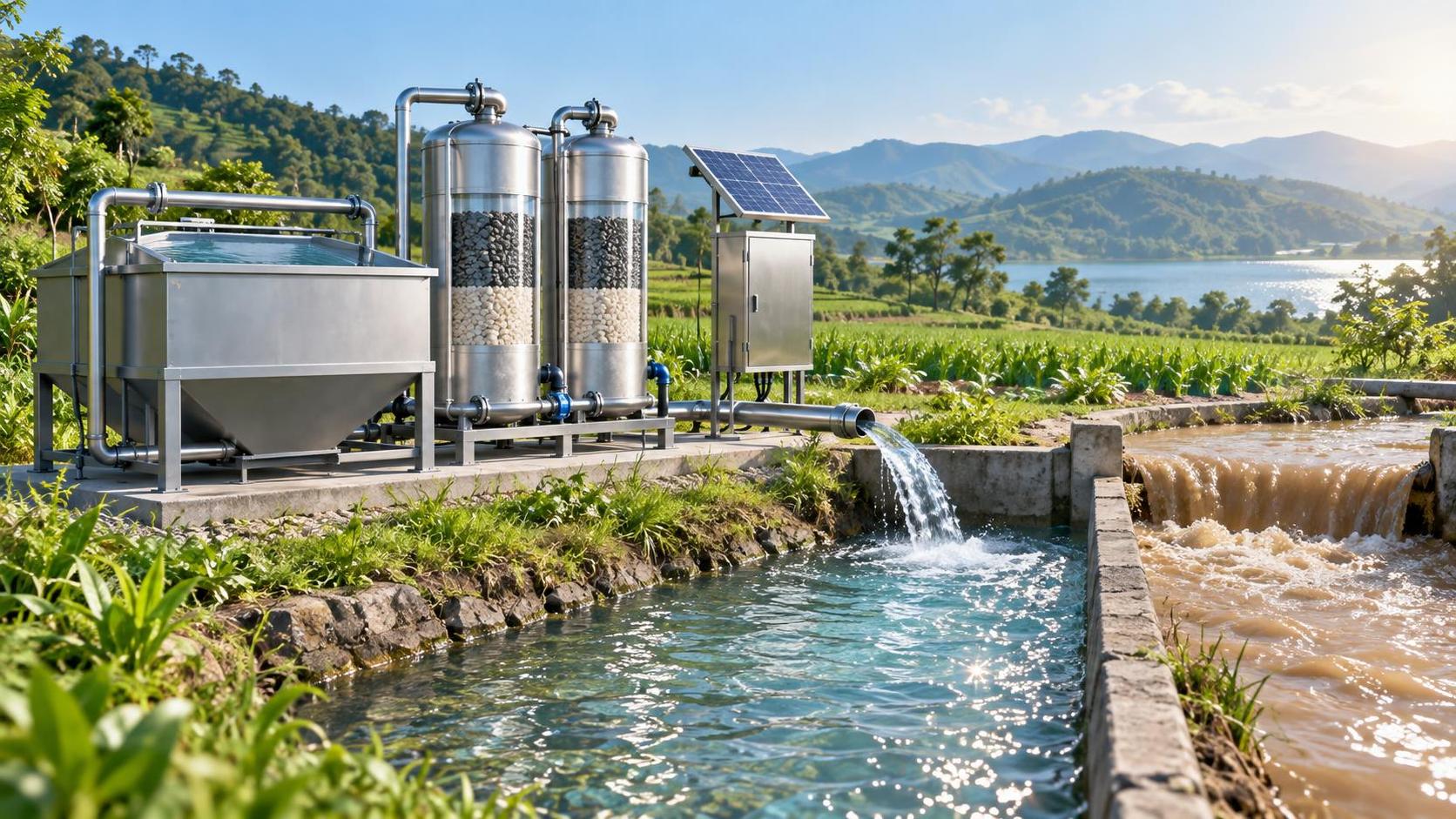
 Small Water Purification System Performance Under Variable Turbidity: Real-World Data from Off-Grid Agricultural Communities
 When Does a Small Water Purification System Outperform Centralized Treatment? Use Cases in Disaster Response and Mining Camps
 Small Water Purification System for Remote Clinics: Power-Independent Options and WHO Drinking Water Guidelines Compliance
 Ultrapure Water Equipment ROI Calculator: Estimating Payback Period Based on Yield Improvement and Defect Reduction
 How Ultrapure Water Equipment Validates Compliance with SEMI F63-1118 for 28nm+ Wafer Fabrication
") Ultrapure Water Equipment for Semiconductor Manufacturing: Key Specifications Beyond Resistivity (TOC, Particle Count, Metals)
Ultrapure Water Equipment for Semiconductor Manufacturing: Key Specifications Beyond Resistivity (TOC, Particle Count, Metals)
GET A FREE QUOTE
Service Commitment: Upon receipt of your message, a dedicated representative will contact you as soon as possible to provide efficient and professional service support.
