







How to restart a skid-mounted sewage treatment plant after storage
Restart a skid mounted sewage treatment plant in stages: inspect the stored equipment, test it with suitable clean water, restore the treatment process, and introduce sewage gradually. Keep startup effluent contained until testing shows that it meets the applicable discharge requirements. A running pump and clear-looking water do not prove that treatment has recovered.
The restart plan depends on how the plant was stored. A drained, preserved unit needs different attention from one left full of stagnant wastewater. The manufacturer’s recommissioning instructions should guide equipment checks, filling sequences, and operating limits.
Establish what happened during storage
Before energizing the skid, review its shutdown records, process diagram, and maintenance history. Identify whether tanks were drained, membranes were preserved, pumps were protected, and chemicals were removed. Also check for freezing, flooding, direct sunlight exposure, or transport damage.
If records are missing, inspect the equipment and retained liquids before deciding what can remain in service. Do not assume that sludge left in a tank is still a useful biological seed, or that a sealed chemical container remains suitable for dosing.
- Stored dry: Look for hardened seals, cracked hoses, corrosion, debris, and components that required wet preservation.
- Stored with wastewater: Expect settled solids, possible blockages, oxygen depletion, and potentially hazardous gases.
- Stored after relocation: Check alignment, supports, pipe connections, grounding, and instruments that may have shifted during transport.
Arrange sufficient holding capacity or an approved alternative treatment route before testing begins. Without somewhere to retain off-spec water, a minor startup problem can become an uncontrolled discharge.
Inspect the skid before applying power
Isolate electrical supplies and release stored pressure before maintenance. Tanks and enclosed treatment compartments can contain oxygen-deficient atmospheres or toxic gases. Do not enter them without the required confined-space controls. Where stagnant wastewater remains, assess gas hazards before opening equipment or starting aeration; odor alone cannot establish whether conditions are safe.
Inspect tank walls, skid supports, anchors, pipework, flexible connections, and drain points. Freeze damage may only become visible during filling. Confirm valve positions against the process diagram, including drain valves and any bypass that could send untreated water directly to the outlet.
Check pumps and blowers using their equipment-specific instructions. Inspect lubrication where applicable, seals, belts, inlet filters, guards, and accessible rotating parts. A seized shaft, damaged coupling, or blocked suction must be corrected before startup. Never run a pump dry unless its design explicitly permits it.
Have qualified electrical personnel inspect cables, terminals, grounding, motor protection, and signs of moisture or pest damage. Electrical testing must account for connected drives and electronic instruments, which can be damaged by inappropriate test methods.
Clean level sensors and probes, then calibrate instruments as required. A fouled level switch can cause an overflow even when every pump works correctly. Test emergency stops, high-level alarms, low-level protection, and equipment interlocks rather than relying on the control panel’s normal status display.
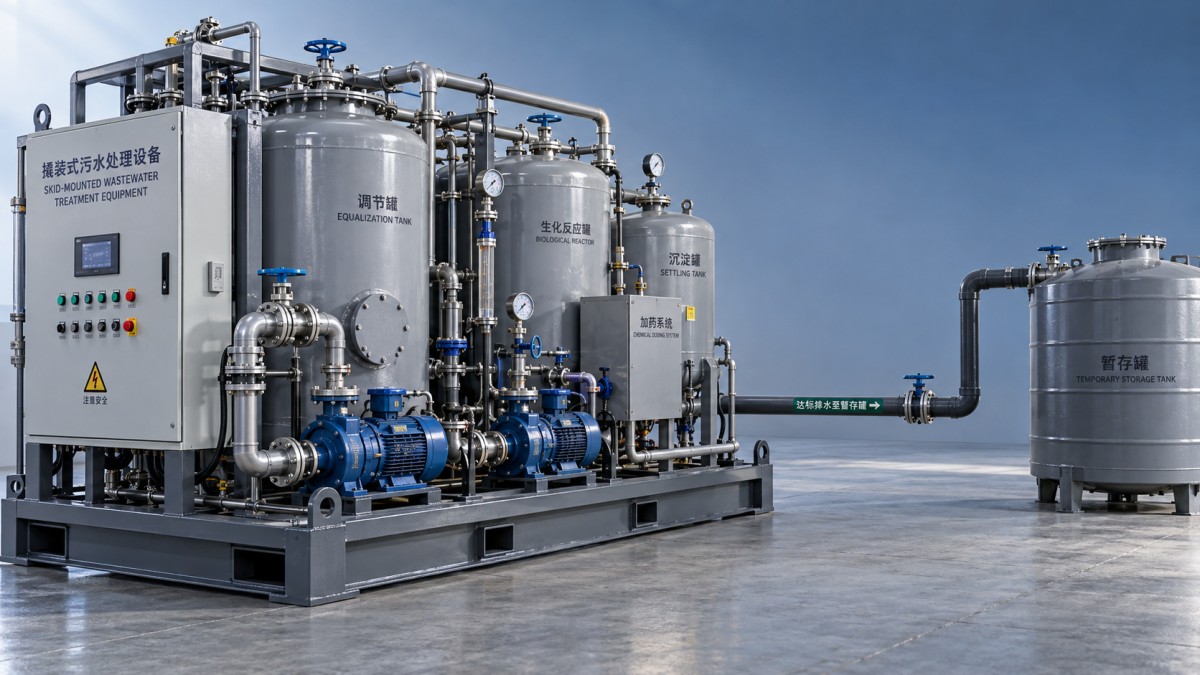
Use clean-water testing to find mechanical problems
Remove debris and deal with retained sludge, wastewater, and preservation liquids through suitable handling routes. Whether old sludge should be retained depends on its condition and the treatment process. Simply flushing everything through the outlet transfers the startup problem downstream.
Fill the plant with water suitable for its materials and process, following the specified sequence. Some tanks and membrane compartments have restrictions on water-level differences. Watch for leaks as levels rise, including at flanges and connections that remained dry during the initial inspection.
Commission equipment individually before testing automatic operation:
- Confirm pump priming and motor rotation using the approved procedure.
- Check flow through transfer, recirculation, sludge-return, and discharge lines.
- Start blowers and inspect air distribution for blocked diffusers, leaks, or uneven delivery.
- Run the automatic sequence and verify that level changes produce the intended response.
- Test duty/standby changeover and power-loss recovery where these functions are installed.
Record unusual noise, vibration, current draw, pressure, and leakage against the equipment’s operating limits. Resolve abnormalities before adding sewage. Clean-water testing can confirm mechanical operation, but it cannot demonstrate biological treatment performance.
Restore the treatment process according to its design
A package sewage plant may use activated sludge, attached-growth media, membranes, chemical treatment, or a combination. Its physical layout does not tell you whether its treatment capacity survived storage.
For biological treatment, establish whether useful biomass remains
Microorganisms need suitable wastewater, oxygen where required, and an appropriate chemical environment. During storage, their activity can decline substantially. Wet sludge may still contain viable organisms, but appearance and smell are poor measures of treatment capacity.
Evaluate retained biomass using relevant process observations and testing. If it is unsuitable or insufficient, arrange compatible seed sludge through the startup plan. The required quantity depends on the process, seed quality, tank volume, and incoming load; a universal seeding dose is not reliable.
Attached-growth systems also need assessment. Media can remain physically intact while its biological activity has deteriorated. Check media retention screens, movement where applicable, and aeration before relying on the biofilm.
For aerobic zones, establish aeration and mixing before controlled feeding. Set dissolved oxygen according to the process requirements. Maximum blower output is not automatically helpful, and anoxic zones should retain their intended operating conditions.
For membrane systems, check preservation before filtration
Follow the membrane supplier’s instructions for removing preservatives, flushing, cleaning, and integrity checks. Some membranes can be damaged by drying, freezing, or incompatible chemicals. Do not apply operating pressure to an uncertain membrane condition and assume that acceptable-looking permeate proves integrity.
Restart filtration within the specified limits and monitor permeability and transmembrane pressure. Poor permeability calls for investigation before increasing suction or pressure.
If the installation includes an auxiliary separation stage, such as equipment listed under Skidmounted Rare Earth Separation and Purification Equipment/Skidmounted Magnetic Flocculation Unit, use that unit’s own recommissioning procedure. Its readiness does not establish that the biological or disinfection stages are ready.
Increase sewage loading only when performance supports it
Begin with a controlled feed suited to the available biological activity and operating capacity. Consider both flow and pollutant strength: a small volume of concentrated wastewater can impose a heavier load than a larger volume of dilute sewage.
Use equalization where available to smooth incoming peaks. Keep cleaning chemicals, solvents, concentrated disinfectants, and other potentially inhibitory discharges out of the startup feed. If the wastewater source has changed since shutdown, reassess its suitability before loading the plant.
Increase loading after the process demonstrates stable performance at the current stage. Avoid a fixed daily increase that ignores falling oxygen, rising ammonia, poor settling, or deteriorating effluent. Hold or reduce the feed when treatment begins to lose stability.
For activated-sludge systems, manage return sludge and wasting together. Excessive wasting can remove recovering biomass; retaining unsuitable sludge indefinitely can also impair operation. Base adjustments on solids measurements, settling behavior, and the process design.
Monitor treatment recovery and decide when discharge can resume
Keep a startup log linking feed conditions, equipment settings, test results, and adjustments. Monitor more frequently while conditions are changing, with particular attention to:
- Loading: Incoming flow, strength changes, and available holding capacity.
- Biological conditions: Dissolved oxygen in aerobic zones, pH, temperature, and alkalinity where nitrification is required.
- Solids separation: Sludge settling, blanket level, suspended solids, or membrane operating trends.
- Effluent quality: The organic, ammonia, solids, and other parameters relevant to the discharge requirements.
- Disinfection: Chemical feed and contact conditions, or UV intensity, sleeve condition, and related operating checks.
Clear effluent can still contain excessive dissolved pollutants or pathogens. Likewise, a single acceptable sample does not establish stable operation. Resume discharge only after the required checks demonstrate compliance under representative operating conditions.
There is no dependable restart duration based solely on storage time. Mechanical condition, surviving biomass, wastewater characteristics, temperature, and discharge limits all affect recovery. Keep loading controlled until repeated observations and test results support normal operation, then record the settings and maintenance findings for the next shutdown.



 Is a skid-mounted sewage treatment plant suitable for repeated relocation?
 How to restart a skid-mounted sewage treatment plant after storage
 How transport limits affect skid-mounted sewage treatment plant design
 What site preparation does a skid-mounted sewage treatment plant need?
 How to verify a modular sewage treatment plant's effluent quality
 Can a modular sewage treatment plant expand without a shutdown?
GET A FREE QUOTE
Service Commitment: Upon receipt of your message, a dedicated representative will contact you as soon as possible to provide efficient and professional service support.
