







Modular Wastewater Treatment Plant
Wastewater projects are often discussed as if the central question were treatment technology: biological process, membrane system, chemical oxidation or disinfection. In practice, many project owners face a more immediate problem. They need compliant treatment capacity before a permanent plant can be designed, financed and constructed, or they need a system that can expand without committing capital to a facility sized for a future that may not arrive.
That is where modular wastewater treatment plants deserve attention. They are not simply smaller versions of conventional centralized plants. A well-designed modular system is an engineering approach built around phased capacity, transportable or prefabricated treatment units, and operating logic that can be adjusted as influent quality, production volumes and discharge requirements change.
For municipalities, industrial parks, remote facilities and aquaculture operations, the value is usually not “compactness” alone. It is the ability to reduce the gap between a pollution-control obligation and a workable commissioning schedule.
The real decision is whether the wastewater profile is stable enough
Modular treatment is often presented as universally flexible, but flexibility has limits. A containerized or skid-mounted plant can be installed relatively quickly; it cannot compensate for an incomplete understanding of influent conditions. Before selecting a process, owners should establish whether flow, pollutant loading and peak variability are known well enough to design for.
This is especially important in industrial wastewater. A factory may report an average daily flow that appears manageable, while intermittent cleaning, batch discharge, seasonal production or raw-material changes create short-duration loads that overwhelm biological treatment or destabilize chemical dosing. In such cases, equalization capacity, emergency storage and source segregation may matter more than the nominal treatment capacity printed on a proposal.
Municipal and rural applications create a different set of questions. Small communities may experience substantial infiltration during rainfall, tourism-driven seasonal peaks or weak sewer collection performance. A modular plant can support staged deployment, but the intake conditions still determine whether the modules should prioritize screening, buffering, biological nutrient removal, tertiary filtration or disinfection.
- Stable wastewater, predictable growth: modular expansion can be a practical alternative to building excess capacity on day one.
- Highly variable industrial wastewater: use modularity with robust equalization, monitoring and pretreatment rather than treating it as a stand-alone answer.
- Remote or temporary operations: prefabricated units may reduce civil-work requirements and shorten installation time, provided power, sludge handling and operator access are addressed.
- Sites with water reuse targets: evaluate the complete reuse train, including filtration, disinfection, storage and distribution, rather than assuming treated effluent is automatically fit for reuse.
Fast deployment does not mean a shortcut around engineering
The strongest case for a modular wastewater treatment plant is usually schedule risk. A standardized treatment unit can reduce on-site fabrication and allow portions of the system to be assembled, tested and instrumented before delivery. This can be useful where an industrial expansion is approaching, a local authority needs interim capacity, or a project is being developed in phases.
However, “rapid installation” is often misunderstood. Mechanical equipment may arrive quickly, while site readiness becomes the actual constraint. Foundations, drainage, electrical supply, inlet pumping, pipe routing, chemical storage, laboratory arrangements, sludge dewatering and discharge connections can all delay commissioning. In cold climates or exposed locations, insulation, ventilation and freeze protection also need early attention.
A procurement team should therefore distinguish between equipment delivery, mechanical completion and stable compliance operation. These are different milestones. The last one depends on process start-up, biomass development where applicable, operator training, analytical testing and correction of control settings. A supplier’s schedule should make those boundaries explicit.
Process selection should follow the discharge objective
There is no single modular process that fits every wastewater stream. For domestic sewage and wastewater with a largely biodegradable organic load, compact biological systems may be appropriate. Depending on local discharge requirements, they may be paired with sedimentation, media filtration, membrane separation or disinfection.
For industrial wastewater, the design sequence is usually more important than the name of any individual technology. Wastewater containing oils, suspended solids, color, difficult-to-degrade organics, high salinity, metals or toxic compounds may require source-specific pretreatment before it reaches a biological stage. Trying to force all streams into one common module can increase operating cost and weaken compliance reliability.
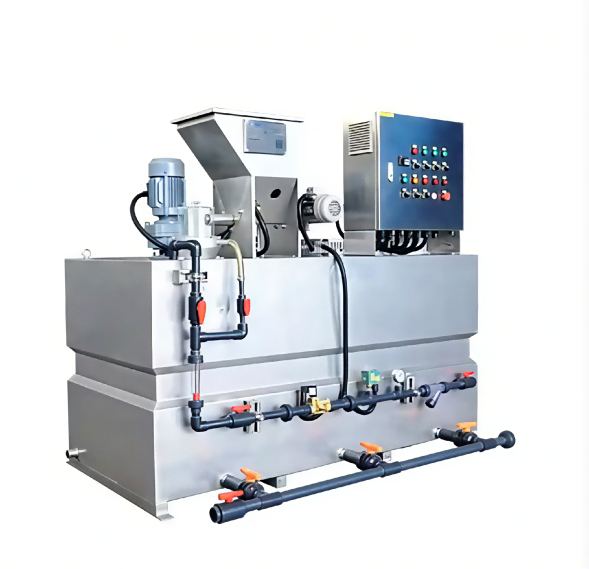
Chemical treatment is often part of this conversation. Coagulation, pH adjustment, phosphorus removal, oxidation and disinfection all depend on controlled chemical addition. A properly matched Dosing Unit (Sewage Treatment / Waterworks / Water Supply System) can be relevant where chemical consumption varies with influent quality, but the equipment itself is only one part of the control strategy. Chemical compatibility, secondary containment, calibration, interlocks and operator procedures deserve equal attention.
The hidden operating issue is not the module, but the operating model
Many modular systems are purchased for sites with limited technical staff. That can be reasonable, but it should lead to a more disciplined operating plan, not an assumption that the plant will run unattended. Even highly automated systems need routine sampling, sensor verification, mechanical inspection, consumable replacement and response procedures for abnormal influent conditions.
Remote monitoring can improve visibility, particularly for distributed municipal facilities or industrial sites with centralized environmental management. Yet alarms have value only when responsibilities are clear. A high-level alarm for pump failure, dissolved oxygen deviation, excessive turbidity or chemical dosing interruption must be linked to someone who can investigate and act within an appropriate timeframe.
Sludge is another frequently deferred issue. Biological and physicochemical treatment both generate residuals, though their characteristics differ. Owners should confirm expected sludge volumes, thickening or dewatering arrangements, storage time, transport logistics and final disposal route. A modular treatment plant can reduce construction complexity while still creating an ongoing waste-management obligation.
How to compare proposals without reducing the decision to price
Capital cost matters, but an unusually low equipment price can conceal exclusions that surface later as change orders or operating burdens. When comparing suppliers, buyers should ask for a clear boundary of supply: civil works, installation, electrical works, control panels, instrumentation, chemical systems, start-up support, performance testing, spare parts and operator training.
Performance guarantees also need careful reading. A meaningful guarantee should identify influent design conditions, effluent limits, sampling method, test duration and the responsibilities of both parties. It is not enough to state that the system will meet a general discharge standard if the allowable loading range and operating assumptions are undefined.
For projects requiring chlorine dioxide, oxidation or advanced disinfection, chemical production or handling systems should be assessed alongside the primary treatment train. Compatibility with existing safety management practices, reagent supply reliability and the required treatment contact conditions can affect overall project performance. Companies with experience across municipal wastewater, industrial water treatment, ecological restoration and chemical dosing applications may be better positioned to assess those interfaces as part of a broader engineering solution rather than as isolated equipment packages.
Modularity works best when it is planned as a lifecycle strategy
The most useful modular wastewater projects are not designed around the smallest possible initial footprint. They are designed around a credible operating path: what happens when flow rises, when discharge limits tighten, when a reuse requirement is added, or when one treatment line must be serviced without stopping the whole plant.
That means reserving space and utility capacity for future modules, using control architecture that can accept additional signals and equipment, and avoiding proprietary arrangements that make later integration unnecessarily difficult. It also means recognizing when a modular facility should remain a long-term asset and when it is better treated as an interim stage before a larger centralized project.
For decision-makers, the relevant question is not whether modular wastewater treatment is more advanced than conventional construction. The question is whether phased, prefabricated capacity gives the site a more reliable path to compliance under its actual hydraulic, operational and financial constraints. When the answer is yes, modularity can turn a difficult timing problem into a manageable treatment program.


GET A FREE QUOTE
Service Commitment: Upon receipt of your message, a dedicated representative will contact you as soon as possible to provide efficient and professional service support.
